
Audiologist Instructions Sheet
MEE audio – Custom Silicone Ear Tip Impressions
1. Tips for Your Audiologist
- Full shell impressions are required for our custom silicone tips. Impressions must include all major parts of the ear, including the full helix, crus of the helix, tragus/tragic notch, and anti-tragus. Be sure to ask for extra material on the outer part of the ear as well. If the impression is missing parts, that could result in it being rejected.
- Impressions must be made with high viscosity silicone impression material and will need to be taken beyond the second bend of the ear canal. Although our custom tips will not go past the second bend, this will ensure that the impression contains enough information about the shape of your canal to secure the fit beyond the first bend.
- You must use a 1–2" bite block while getting your impression taken in order to limit jaw movement while the material hardens, as well as to accommodate the change in the canal shape when opening your mouth. This open mouth impression technique will produce better results in terms of seal and noise isolation.
Important: We will not accept impressions that have already been cut or trimmed. Do not remove the foam/cotton block.
2. Acceptable Impressions

Acceptable impressions include all major parts of the ear (full helix, crus of the helix, tragus/tragic notch, anti-tragus) with adequate extra material on the outer ear and the foam/cotton block intact.
↑ Back to top3. Rejectable Impressions
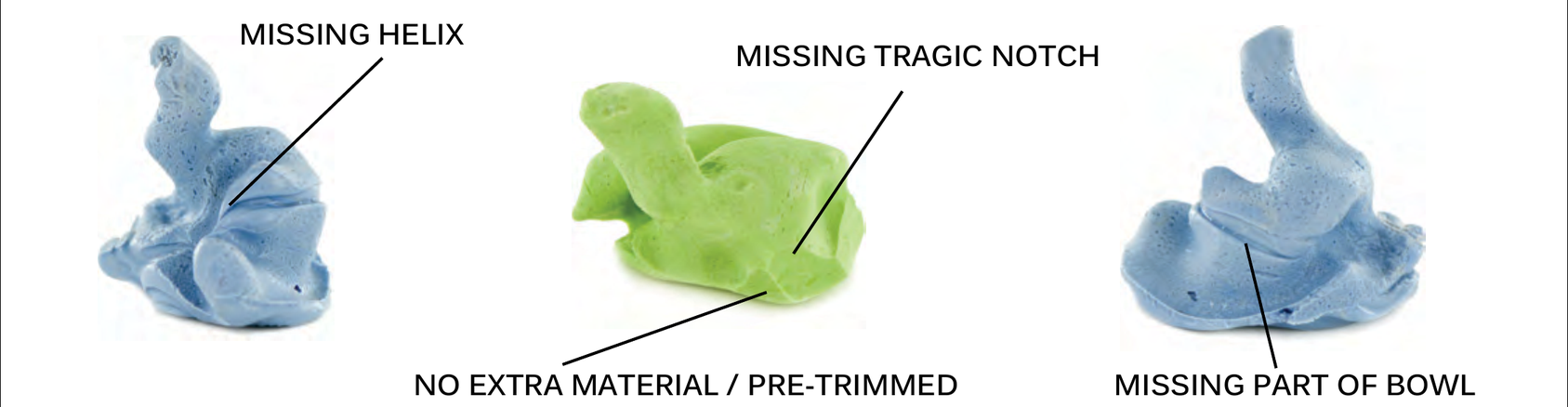
Impressions will be rejected for any of the following reasons:
- Missing helix — the full helix is not present in the impression.
- Missing tragic notch — the tragus/tragic notch is absent.
- No extra material / pre-trimmed — the impression has been cut or trimmed before submission.
- Missing part of bowl — part of the bowl (concha) is absent from the impression.